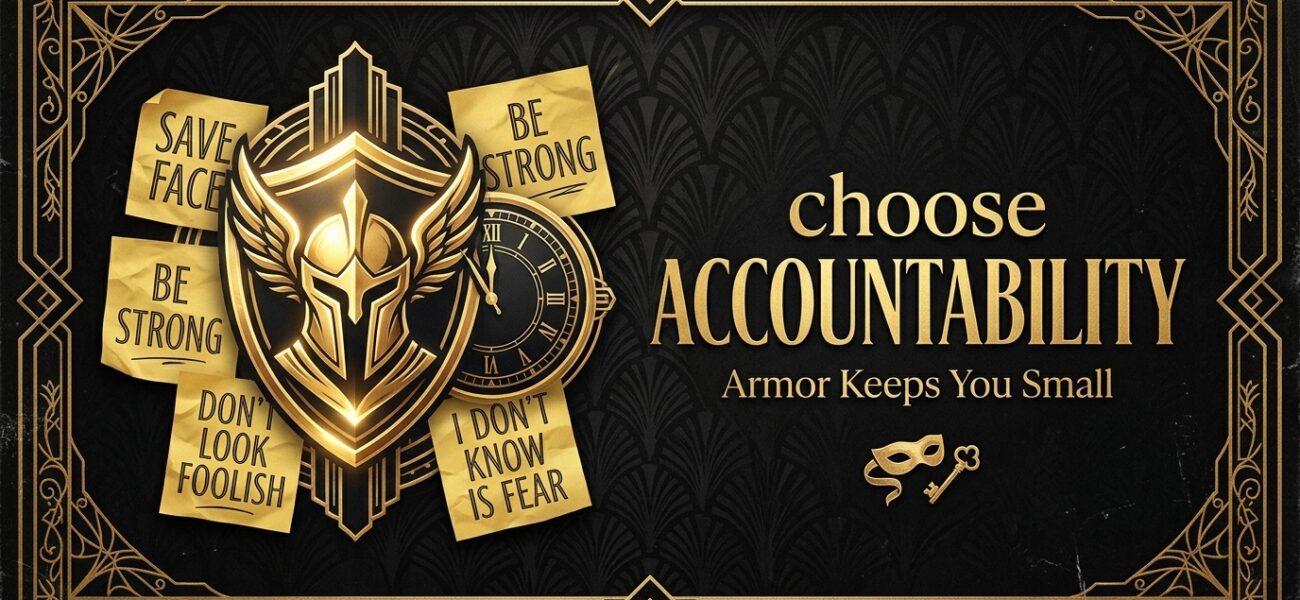
We live in a culture obsessed with curated appearances. From polished social feeds to carefully guarded professional personas, the impulse to “save face” is universal. We tell ourselves we are keeping up appearances to look capable, confident, and complete. But saving face is not the path to a life of abundance, joy, or progress. In reality, saving face is an exhausting performance—a defense mechanism designed to protect us from exposure.
The real key to personal transformation isn’t just taking off the mask; it is surviving the moment right after you drop it. Mask removal requires an ample amount of personal accountability, and that is precisely where most people get stuck.
The Trap of the Protective Mask
When we talk about wearing masks, we usually label it as “fakeness” or hypocrisy. But calling it fake misses the point. Most people do not put on a mask out of deception; they wear it for protection.
The mask is armor. It shields us from the pain of being judged, failing publicly, or admitting that we don’t have all the answers. Over time, we become attached to this protective barrier because it gives us a sense of control. As psychological research into objective self-awareness demonstrates, directing our attention inward naturally forces us to evaluate ourselves against our internal standards (Duval & Wicklund, 1972). When there is a gap between who we pretend to be and who we actually are, the discomfort is intense.
To avoid that discomfort, we put the mask right back on. Letting go of fakeness is easy once you see through it, but letting go of what feels like self-preservation? That is infinitely harder.
Why Accountability Makes Us “Shy”
When you decide to remove the mask, accountability stands waiting at the door. Taking off the mask means owning your flaws, acknowledging past missteps, and admitting where you need to grow.
This is the exact moment many people get “shy” and retreat. The sudden exposure feels dangerous, so they pull the mask back over their faces—not because they want to lie, but because the raw vulnerability of being seen without a shield feels unbearable.
However, hiding behind armor halts all meaningful growth:
- It blocks true emotional intelligence: Higher self-awareness and self-reflection are directly linked to better emotional regulation and impulse control (Abdel-Hadi & Gharaibeh, 2023). When you hide behind a persona, you cannot develop genuine emotional self-awareness (Paoletti & Dotan Ben-Soussan, 2021).
- It suffocates personal leadership: True self-leadership requires internal motivation, honest self-observation, and accountability rather than external performance (Faulkner, 2026; Merlin & Soubramanian, 2024).
- It traps you in fear: Modern self-help and human agency thrive on active self-optimization (Nehring, 2024). Retreating behind a mask keeps you frozen in a cycle of self-defense.
Trading Armor for Abundance
To live a life marked by joy and progress, you have to trade the comfort of protection for the freedom of accountability. Practices like self-reflective journaling allow us to process difficult internal states and move toward an authentic self without fear of judgment (Moses, 2019). Furthermore, mindfulness frameworks show that reducing rigid, protective ego-reactions creates room for true self-transcendence and deeper human connection (Vago & Silbersweig, 2012).
Accountability isn’t a punishment for being imperfect; it is the price of admission for real progress. The next time you feel the urge to retreat into the safety of saving face, remember that the mask only protects the small, fearful version of who you are. Step out from behind the shield, embrace the discomfort of being seen, and build a life rooted in truth.
In Saving Face, author Vyvon S. Duhon exposes how the fear of looking foolish and hiding behind a mask of perfection keeps us small. True growth requires letting go of protection and choosing real accountability. Step out of the shadows today—get your copy at books.by/vyvon.